A Beginner's Guide to Cryptoeconomics

A Beginner's Guide to Cryptoeconomics

Beginner
განახლებული Jun 8, 2026
7m

Key Takeaways

  • Cryptoeconomics combines cryptography and economics to coordinate participants in decentralized networks like Bitcoin and Ethereum.

  • It uses incentives and penalties to encourage honest behavior, making it more profitable for participants to follow the rules than to break them.

  • In Bitcoin, miners are rewarded with new bitcoins for validating transactions, which aligns their financial interests with the security of the network.

  • Cryptoeconomic principles also underpin proof-of-stake networks, DeFi protocols, and governance token systems.

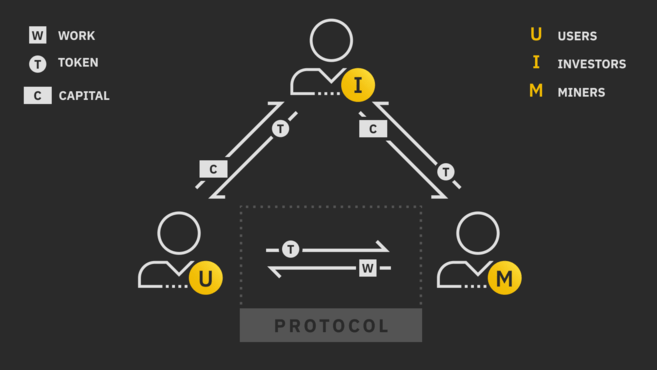
  • The cryptoeconomic circle, a model by Joel Monegro, describes how miners, users, and investors each play a role in sustaining a token-based economy.

Binance Academy courses banner

Introduction

Cryptoeconomics is the study of how to build decentralized systems that work reliably, even when participants may have competing interests. It does this by combining cryptography (the math behind secure communication) with economic incentives. The result is a framework that can coordinate strangers on a blockchain without requiring them to trust each other or a central authority.

This article explains what cryptoeconomics is, why it matters, and how it works in practice in networks like Bitcoin and Ethereum.

What Is Cryptoeconomics?

Cryptoeconomics is a field of computer science that uses cryptographic tools and economic incentives to design reliable decentralized networks. The goal is to make honest behavior more rewarding than dishonest behavior for every participant.

Think of it as the rules of a game where players are strangers who cannot fully trust each other. Cryptoeconomics designs the game so that following the rules is the rational choice, regardless of a player's intentions.

The concept became practical with the launch of Bitcoin in 2009. Before Bitcoin, it was difficult to build a financial system without a trusted middleman like a bank. Cryptoeconomics made it possible to remove that middleman by replacing trust with verifiable mathematics and financial incentives.

What Problem Does Cryptoeconomics Solve?

The core challenge in any decentralized network is coordination. If participants can act freely without consequences, some may try to cheat the system. For example, in a digital payment network, a bad actor might try to spend the same coins twice (a double-spend attack) or manipulate transaction records.

Traditional solutions rely on a central authority to prevent this, such as a bank verifying balances. Decentralized systems cannot use this approach. Instead, cryptoeconomics replaces the central authority with a combination of cryptographic proofs and economic incentives that make cheating unprofitable.

If the cost of attacking a network exceeds the potential reward, rational actors will not attempt it. Cryptoeconomics is the discipline that designs and evaluates these cost structures.

The Role of Cryptoeconomics in Bitcoin Mining

Bitcoin uses a consensus mechanism called proof-of-work to validate transactions. Miners compete to solve a complex mathematical puzzle, and the winner adds the next block of transactions to the blockchain and receives a block reward in bitcoin.

This design is cryptoeconomic because it ties financial reward to honest behavior. A miner who tries to include fraudulent transactions in a block will have that block rejected by the rest of the network, wasting their investment in computing hardware and electricity. Honest miners, by contrast, collect steady rewards over time.

The rules also include difficulty adjustments, which automatically increase or decrease the puzzle's difficulty based on how many miners are active. This keeps block times roughly constant at 10 minutes and ensures the network can scale up or down without losing stability.

How Does Cryptoeconomics Secure Bitcoin?

The security of Bitcoin depends on miners having more to gain from honest behavior than from attacks. An attacker who wants to rewrite transaction history would need to control more than 50% of the network's total computing power (a 51% attack). At Bitcoin's current scale, this would require an enormous investment in hardware and energy.

Even if an attacker managed to gain that level of control, the damage to Bitcoin's value caused by a successful attack would likely reduce the value of any rewards they might earn. The incentives are designed so that the attack is both expensive and potentially self-defeating.

This does not mean such attacks are impossible, particularly on smaller networks with fewer miners. But for large, established networks, the cryptoeconomic design makes sustained attacks economically irrational.

Beyond Bitcoin: Cryptoeconomics in Proof-of-Stake and DeFi

Cryptoeconomic principles extend beyond proof-of-work. Proof-of-stake networks like Ethereum (which completed its transition from proof-of-work in September 2022) use a different but related model. Instead of spending computing power, validators stake (lock up) cryptocurrency as collateral. Dishonest validators risk having their stake "slashed," meaning a portion is automatically destroyed as a penalty.

In decentralized finance (DeFi), cryptoeconomics shapes how liquidity providers are rewarded, how governance token holders vote on protocol changes, and how lending protocols manage risk. Each of these systems relies on carefully designed incentives to function without a central authority.

Governance tokens are a particularly interesting development. They give holders the right to vote on changes to a protocol's rules, creating a form of on-chain democracy. The economic design of these systems, including how much influence one token carries and what decisions require a supermajority, is itself a form of cryptoeconomics.

The Cryptoeconomic Circle

The cryptoeconomic circle is a model published by Joel Monegro that describes how value flows through a token-based economy. It identifies three main groups of participants: miners (or validators), who supply the network's computing or staking capacity; users, who demand the network's services; and investors or holders, who provide capital and support token prices.

In this model, miners are paid with tokens by users. Traders create liquidity so miners can convert tokens to cash to cover operating costs. Holders support token prices over time by reducing the circulating supply. Each group depends on the others to sustain the ecosystem.

The model helps highlight potential weaknesses. For example, if holders concentrate too much of the supply, the network may become more centralized over time. If miner rewards decline faster than transaction fee income grows, miners may leave, reducing network security.

FAQ

What is cryptoeconomics in simple terms?

Cryptoeconomics is the use of math and financial incentives to make decentralized networks work reliably. It ensures that participants who follow the rules are rewarded, while those who try to cheat are penalized.

Why is cryptoeconomics important for blockchain networks?

Blockchain networks have no central authority to enforce rules. Cryptoeconomics replaces that authority with a combination of cryptographic proofs and economic incentives, making it more profitable for participants to behave honestly than to attack the network.

How does cryptoeconomics work in Bitcoin?

In Bitcoin, miners are rewarded with new bitcoins for adding valid transaction blocks to the chain. The rules make it computationally expensive to attempt fraud, and the rewards ensure that honest miners are better off than attackers over time.

Does cryptoeconomics apply to proof-of-stake networks?

Yes. Proof-of-stake networks like Ethereum use staking and slashing (automatic penalties) instead of mining. Validators put up cryptocurrency as collateral and risk losing it if they behave dishonestly. The economic incentives are similar in principle to those in proof-of-work systems.

What is the cryptoeconomic circle?

The cryptoeconomic circle is a model by Joel Monegro that describes how miners, users, and investors interact in a token-based economy. Each group depends on the others: miners supply the network, users pay for services, and investors provide capital. The model helps analyze the health and sustainability of a decentralized network.

Closing Thoughts

Cryptoeconomics is a foundational concept in blockchain design. By aligning financial incentives with honest behavior, it allows decentralized networks to function without requiring participants to trust each other. Bitcoin demonstrated that this approach could work at scale, and the principles have since spread to proof-of-stake networks, DeFi protocols, and governance systems.

As blockchain networks continue to evolve, cryptoeconomic design will remain central to how developers build systems that are both secure and sustainable. Understanding the basics can help anyone engage more meaningfully with blockchain projects.

Further Reading

Disclaimer: This content is presented to you on an "as is" basis for general information and educational purposes only, without representation or warranty of any kind. It should not be construed as financial, legal, or other professional advice, nor is it intended to recommend the purchase of any specific product or service. You should seek your own advice from appropriate professional advisors. Where the content is contributed by a third-party contributor, please note that those views expressed belong to the third-party contributor, and do not necessarily reflect those of Binance Academy. Digital asset prices can be volatile. The value of your investment may go down or up and you may not get back the amount invested. You are solely responsible for your investment decisions and Binance Academy is not liable for any losses you may incur. For more information, see our Terms of Use, Risk Warning and Binance Academy Terms.

პოსტების გაზიარება
დაარეგისტრირეთ ანგარიში
თქვენი ცოდნის პრაქტიკაში გამოსაყენებლად გახსენით Binance-ის ანგარიში დღესვე.